
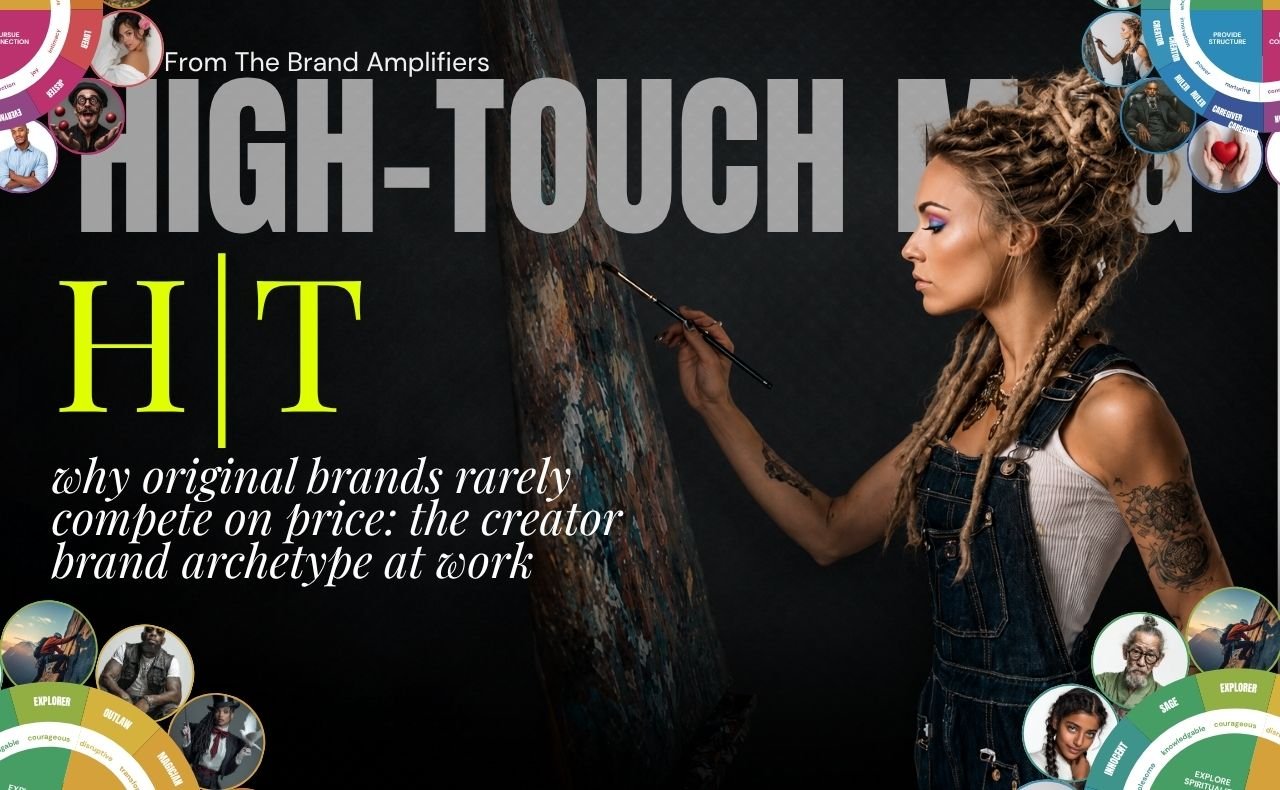
WHY ORIGINAL BRANDS RARELY COMPETE ON PRICE: THE CREATOR BRAND ARCHETYPE AT WORK
Every market eventually reaches the same destination.
Products become increasingly similar. Features that once justified premium pricing become industry standards. Competitors replicate innovations faster than ever, while artificial intelligence accelerates the production of marketing campaigns, product concepts, and even customer experiences. What was once distinctive quickly becomes expected.
For many businesses, the response is predictable.
Lower the price.
Increase the discount.
Launch another promotion.
Spend more on advertising.
Fight harder for attention.
It feels like a logical strategy until every competitor begins doing exactly the same thing. Margins shrink, differentiation disappears, and customers become conditioned to wait for the next sale rather than paying full price.
Yet some brands never seem to enter this race.
Apple rarely competes through discounts despite operating in one of the world's most competitive technology markets. LEGO continues commanding premium prices decades after its original patents expired. Dyson transformed everyday household appliances into premium purchases. Adobe reinvented creative software by becoming synonymous with professional creativity rather than simply selling design tools.
These companies operate under different competitive rules.
Their advantage isn't simply superior products. It isn't larger advertising budgets or more aggressive sales strategies. Their greatest competitive advantage is that they have built something competitors struggle to imitate: originality.
Original brands don't ask how to become slightly better than the competition. They ask how to become impossible to compare in the first place.
This is the strategic power of the Creator Brand Archetype.
Far too often, discussions about brand archetypes reduce them to personality labels or creative exercises. Businesses are encouraged to choose an archetype because it feels inspiring, then adjust their colors, messaging, or social media tone to match.
That approach completely misses their strategic value.
Brand archetypes are not aesthetic frameworks. They are competitive frameworks.
They define how a business creates value, how customers perceive that value, and ultimately why customers choose one brand over another when dozens of alternatives exist.
The Creator Brand Archetype represents businesses that compete through innovation, imagination, craftsmanship, and originality. These organizations aren't interested in becoming another option within an existing category. Their ambition is to reshape the category itself.
Rather than competing on price, they compete on ideas.
Rather than following industry standards, they redefine them.
Rather than chasing demand, they create it.
For premium businesses, this distinction is becoming increasingly important.
Artificial intelligence has dramatically reduced the cost of producing content, launching campaigns, designing visuals, and generating product ideas. Competitors now have access to remarkably similar technology, marketing platforms, and customer insights. Functional advantages disappear faster than ever.
Originality has become one of the few competitive assets that cannot be mass-produced overnight.
Technology can replicate execution.
It cannot replicate vision.
Customers recognize this difference intuitively.
When a brand consistently introduces fresh thinking, distinctive design, or genuinely new ways of solving familiar problems, customers stop evaluating purchases purely through price. Instead, they begin evaluating creativity, innovation, expertise, and identity. The conversation shifts from cost to value, from comparison to preference.
That shift creates extraordinary commercial advantages.
Original brands experience lower price sensitivity, stronger customer advocacy, greater media attention, and higher perceived expertise. They become reference points within their industries rather than participants competing inside them.
This explains why the world's most admired businesses rarely define themselves by what they sell.
Apple doesn't market smartphones. It champions creativity through technology.
LEGO doesn't simply manufacture toys. It unlocks imagination across generations.
Airbnb transformed hospitality by reimagining how people experience travel rather than building another hotel chain.
These organizations aren't selling products first.
They're selling original ways of seeing the world.
That distinction is precisely what the Creator Brand Archetype protects.
Why Original Brands Rarely Compete on Price
One of the biggest misconceptions in business is that pricing determines competitiveness.
In reality, pricing often reflects positioning rather than creating it.
Businesses lower prices when customers struggle to understand why their offering deserves a premium. Price becomes the easiest variable to adjust because the brand itself has failed to establish sufficient differentiation.
This creates a dangerous cycle.
A competitor introduces a discount.
Another business responds with a larger discount.
Margins shrink.
Marketing budgets increase to compensate.
Customer acquisition becomes more expensive.
Brand perception weakens because customers begin associating the business with affordability instead of value.
Eventually, the entire market competes on price because no one has created a compelling reason not to.
Original brands escape this cycle by changing the basis of comparison altogether.
Instead of asking customers to compare prices, they encourage customers to compare experiences.
Instead of emphasizing features, they emphasize innovation.
Instead of promoting affordability, they communicate originality.
This is where the Creator Brand Archetype creates measurable business value.
Customers don't expect Creator brands to be the cheapest.
They expect them to be different.
That expectation fundamentally changes purchasing behavior.
Behavioral economics consistently demonstrates that consumers rarely evaluate premium purchases through logic alone. Functional considerations certainly matter, but emotional factors such as identity, aspiration, creativity, exclusivity, and trust frequently determine whether customers perceive premium pricing as justified.
Originality strengthens all of these drivers simultaneously.
A beautifully designed product communicates craftsmanship before anyone experiences its performance.
A genuinely innovative service signals expertise before results are delivered.
A distinctive brand identity builds memorability before customers make a purchase.
Originality becomes evidence of competence.
That perception compounds over time.
Consider Apple.
Numerous smartphones match—or even exceed—Apple's technical specifications in individual categories. Yet millions of customers willingly pay a premium because Apple has consistently positioned itself as the company that reimagines how technology fits into people's lives.
Customers aren't simply buying hardware.
They're buying participation in an ecosystem built around creative thinking, intuitive design, and continuous innovation.
The same principle explains why premium furniture brands, luxury fashion houses, boutique hospitality companies, and high-end professional service firms rarely compete through aggressive discounting.
Their pricing reflects perceived originality rather than production costs.
This represents one of the most important strategic lessons behind the Creator Brand Archetype.
Businesses don't command premium prices because they charge more.
They charge more because customers believe they create something competitors cannot easily reproduce.
Originality creates differentiation.
Differentiation creates perceived value.
Perceived value creates pricing power.
Pricing power creates sustainable competitive advantage.
Price becomes the outcome of originality—not the strategy itself.
What Is the Creator Brand Archetype?
Despite its name, the Creator Brand Archetype is not limited to artists, designers, architects, or creative agencies.
It represents any organization committed to producing something genuinely distinctive.
The defining characteristic of the Creator is not artistic talent.
It is original thinking.
Creator brands refuse to compete by copying successful competitors or following industry conventions. Instead, they challenge assumptions, explore new possibilities, and continually raise expectations within their categories.
They believe innovation is not an occasional campaign.
It is an operating philosophy.
This mindset influences every part of the business—from product development and customer experience to leadership, communication, and long-term strategy.
The Creator Brand Archetype asks a fundamentally different question than most businesses:
"How can we build something customers have never experienced before?"
Rather than asking:
"How can we sell more of what everyone else already offers?"
That shift transforms the entire organization.
Innovation becomes cultural rather than departmental.
Creativity becomes strategic rather than cosmetic.
Differentiation becomes intentional rather than accidental.
This is why the Creator Brand Archetype extends far beyond marketing. It shapes product innovation, customer experience, brand voice, service design, leadership decisions, and long-term business positioning.
If you're still defining your brand's core personality and strategic positioning, understanding the broader framework of Brand Archetypes provides the foundation for determining whether the Creator genuinely reflects your business or whether another archetype offers a stronger strategic fit.
Why the Creator Brand Archetype Builds Premium Brand Positioning
Premium positioning is often misunderstood.
Many businesses assume becoming premium means increasing prices, investing in better packaging, redesigning their website, or adding words like exclusive, luxury, and premium to their marketing. These changes may influence perception temporarily, but they rarely create sustainable pricing power.
True premium positioning begins long before a customer sees the price.
It begins with originality.
This is where the Creator Brand Archetype creates one of the strongest competitive advantages available to modern businesses.
Creator brands don't become premium because they charge more. They charge more because customers perceive them as creating something that competitors cannot easily reproduce. Their value is rooted in innovation, craftsmanship, creativity, and a distinctive way of solving problems. Those qualities shift the conversation away from price and toward significance.
This distinction matters because markets have changed dramatically.
Consumers today can compare products instantly. Competitors can reverse-engineer features in months instead of years. Artificial intelligence allows businesses to generate advertisements, product descriptions, and marketing campaigns within minutes. Functional advantages have become increasingly temporary.
Original thinking has become significantly harder to copy.
Customers recognize this difference.
When a business consistently introduces fresh ideas, distinctive design, or a unique customer experience, it stops being evaluated alongside every alternative in the market. Instead, it establishes its own competitive space.
This explains why Apple is rarely compared solely on specifications.
Why Dyson transformed ordinary household appliances into premium products.
Why LEGO remains the global leader in creative play despite decades of imitation.
Their products matter.
But their originality matters more.
The Creator Brand Archetype transforms innovation into perceived value, and perceived value becomes premium positioning.
Businesses often believe competitors are their greatest challenge.
In reality, commoditization is the greater threat.
When products appear interchangeable, customers naturally compare prices. Every additional competitor makes pricing pressure more intense because there is little else separating one business from another.
The Creator Brand Archetype breaks this cycle by making comparison increasingly difficult.
Originality creates differentiation.
Differentiation creates memorability.
Memorability creates preference.
Preference reduces price sensitivity.
That sequence explains why original brands consistently outperform businesses that compete primarily through promotions or discounts.
This is also why originality should never be viewed as a creative exercise.
It is a commercial strategy.
If your business is still competing primarily through features or pricing, it may indicate that your differentiation isn't yet strong enough. Understanding how brand archetypes shape positioning is often the first step toward building a business customers recognize before they compare. (Internal link: Identify Your Brand Archetypes)
Originality Is a Competitive Advantage, Not a Creative Exercise
Many organizations treat creativity as a marketing function.
It becomes the responsibility of designers, advertising agencies, or content teams. Creativity is measured by attractive visuals, memorable campaigns, or engaging social media posts.
The Creator Brand Archetype approaches creativity very differently.
Originality is not something added after strategy.
It is the strategy.
This distinction separates businesses that occasionally produce innovative campaigns from organizations that consistently redefine their industries.
Original brands ask different questions.
Instead of asking:
"How can we make this campaign more creative?"
They ask:
"How can we solve this problem in a way nobody else has considered?"
That mindset extends far beyond advertising.
It influences product design.
Customer experience.
Business models.
Technology.
Leadership.
Pricing.
Service delivery.
Every decision becomes an opportunity to reinforce the brand's originality.
Consider Airbnb.
The company did not become one of the world's largest hospitality brands because it built better hotels.
It succeeded because it fundamentally challenged the assumptions of the hotel industry.
The same principle applies to Adobe.
Rather than competing as another software company, Adobe positioned itself as the platform powering the world's creative professionals. Its products became synonymous with creativity itself.
Neither company won because of lower prices.
They won because they reframed the category.
This ability to reshape expectations is one of the defining characteristics of the Creator Brand Archetype.
Originality changes customer psychology.
People stop asking:
"Which option is cheaper?"
They begin asking:
"Which option is more innovative?"
That subtle shift has enormous commercial implications.
Innovation attracts media attention.
Distinctive products generate organic conversations.
Creative businesses earn stronger referrals.
Unique experiences become stories customers naturally share.
Originality reduces the need to compete aggressively for attention because the market begins discussing the brand voluntarily.
This creates a compounding effect.
Innovation builds visibility.
Visibility builds authority.
Authority strengthens trust.
Trust increases perceived value.
Perceived value supports premium pricing.
Businesses often search for growth through larger advertising budgets.
Creator brands frequently achieve growth because originality itself becomes marketing.
The Original Value Framework™
Most businesses attempt to build premium brands by focusing on pricing or aesthetics.
The strongest Creator brands build premium value through a much deeper process.
At The Brand Amplifiers, we describe this progression as The Original Value Framework™.
Rather than treating originality as a creative output, the framework positions it as the foundation of long-term commercial value.
Stage 1: Original Thinking
Every exceptional brand begins by questioning assumptions instead of following conventions.
Innovation starts with perspective, not products.
Creator brands challenge industry norms before introducing solutions.
Stage 2: Distinctive Positioning
Original ideas must be translated into a market position customers immediately understand.
Rather than competing within existing categories, Creator brands establish a position competitors struggle to imitate.
Stage 3: Memorable Experiences
Original positioning becomes believable through customer experience.
Every interaction should reinforce the same innovative promise.
This is where brand voice, product design, customer service, and every touchpoint work together to create consistency. (Internal link: Brand Voice Starts With Brand Archetype)
Stage 4: Premium Perception
As customers repeatedly experience originality, innovation becomes associated with expertise.
The brand earns permission to command higher prices because customers perceive greater value before making a purchase.
Stage 5: Pricing Power
The final outcome is not expensive products.
It is reduced price sensitivity.
Customers stop evaluating the business purely through cost because originality has become part of the value proposition itself.
This framework demonstrates an important principle.
Premium pricing is rarely the starting point.
It is the result of consistently delivering something customers cannot easily replace.
Why Customers Pay More for Original Brands
One of the most common questions founders ask is simple:
"Why would someone pay more when similar alternatives exist?"
The answer has very little to do with logic.
Behavioral economists have repeatedly shown that purchasing decisions are heavily influenced by emotion before being justified with rational explanations.
Customers often explain premium purchases using words such as quality, craftsmanship, durability, or innovation.
Those reasons matter.
But they rarely tell the complete story.
People pay more because original brands change how they feel.
They create confidence.
They reinforce identity.
They signal taste.
They represent aspiration.
The Creator Brand Archetype excels because it understands that customers rarely purchase products alone.
They purchase ideas.
They purchase belonging.
They purchase the feeling of participating in something genuinely distinctive.
Consider why millions of professionals choose Apple's ecosystem despite countless alternatives offering similar functionality.
The decision extends beyond hardware specifications.
Apple represents creativity.
Innovation.
Simplicity.
Design excellence.
Owning an Apple product reinforces an identity customers already value.
The same principle explains why architects specify premium materials, why photographers invest in Leica cameras, or why entrepreneurs choose beautifully designed workspaces over cheaper alternatives.
Originality creates emotional significance.
Emotional significance creates perceived value.
Perceived value justifies premium pricing.
Businesses frequently attempt to justify higher prices by adding more features.
Creator brands justify premium pricing by making customers believe there is nothing else quite like what they offer.
That is a fundamentally different competitive strategy.
It also explains why originality has become one of the most valuable business assets in an increasingly commoditized marketplace.
The Creator Brand Archetype in Customer Experience
Many organizations believe innovation happens inside research and development departments.
Creator brands understand something different.
Innovation becomes meaningful only when customers experience it consistently.
This is why the Creator Brand Archetype extends far beyond product development. It influences how customers discover your business, interact with your team, experience your services, and ultimately describe your brand to others. Every interaction either reinforces originality or quietly undermines it.
Consider Apple.
Its innovation isn't limited to the iPhone or MacBook. The experience begins long before a purchase. Apple Stores encourage exploration rather than transactions. Packaging reflects meticulous attention to detail. Software integrates seamlessly across devices. Even customer support reinforces simplicity and thoughtful design.
Every touchpoint communicates the same message:
"This brand creates differently."
That consistency is what transforms innovation into trust.
Many businesses unintentionally break this experience.
Marketing promises innovation.
The website feels generic.
Customer onboarding follows an outdated process.
Support relies on scripted responses.
The result is a disconnect between positioning and reality.
Customers don't evaluate brands based solely on what they claim.
They evaluate whether every interaction reinforces the promise being made.
This is why customer experience has become one of the strongest expressions of brand strategy.
If your positioning emphasizes originality, your customer journey should feel equally distinctive.
If your messaging celebrates creativity, your communication should reflect it.
If your business claims to challenge convention, customers should encounter that thinking at every stage of the relationship.
Originality isn't something customers read.
It's something they experience.
That experience becomes even stronger when every department communicates with a consistent brand voice that reflects the same creative philosophy, reinforcing innovation across every customer interaction rather than limiting it to marketing campaigns.
Why AI Makes Original Brands More Valuable
Artificial intelligence is changing business faster than almost any technology before it.
Content can be generated within seconds.
Advertisements can be written automatically.
Images can be produced almost instantly.
Marketing campaigns that once required weeks now take hours.
For many organizations, this creates an exciting opportunity.
For Creator brands, it creates something even more important.
A competitive advantage.
As AI becomes accessible to everyone, execution becomes increasingly commoditized.
Thousands of businesses now have access to the same writing tools.
The same design software.
The same automation platforms.
The same predictive analytics.
The same customer insights.
Technology has dramatically lowered the cost of producing acceptable work.
It has not lowered the difficulty of producing original thinking.
That distinction matters.
AI excels at recognizing existing patterns.
Creator brands succeed by creating new ones.
Artificial intelligence can generate another logo inspired by successful competitors.
It cannot imagine a category customers haven't yet considered.
It can summarize existing ideas.
It struggles to invent entirely new strategic directions.
This is why originality becomes more valuable—not less—in the AI era.
Businesses that rely solely on AI-generated marketing will gradually begin sounding remarkably similar.
The same headlines.
The same positioning.
The same promises.
The same customer journey.
Consumers are already learning to recognize this pattern.
Original brands stand apart because they contribute ideas rather than recycle them.
They publish original research.
Develop proprietary frameworks.
Challenge industry assumptions.
Offer perspectives competitors haven't articulated.
That kind of originality becomes increasingly valuable to both customers and AI-powered search engines.
Modern search is evolving beyond keywords.
Platforms like Google AI Overviews, ChatGPT, Gemini, Claude, and Perplexity increasingly prioritize brands demonstrating genuine expertise, unique insights, and consistent authority.
Original thinking becomes a discoverability advantage.
Businesses producing distinctive perspectives become easier to reference, easier to cite, and more likely to be recommended by AI-driven search experiences.
In an economy where anyone can generate content, the brands that generate ideas will lead the conversation.
This is precisely why AI brand authority is becoming inseparable from originality rather than content volume.
Creator Brand Archetype Examples
The strongest Creator brands don't simply innovate.
They redefine customer expectations.
Their products may differ dramatically, but they all compete through originality rather than imitation.
Apple
Apple transformed consumer technology by combining innovation with elegant simplicity.
Its products are rarely the cheapest.
Customers invest because Apple consistently delivers experiences competitors struggle to replicate.
Dyson
Dyson challenged assumptions surrounding ordinary household appliances.
Vacuum cleaners became engineering showcases.
Hair dryers became technological innovations.
Every product reinforced the same commitment to inventive problem-solving.
LEGO
Despite decades of imitation, LEGO remains synonymous with creative play.
Its success isn't built on plastic bricks.
It's built on imagination.
The brand continually expands creativity through education, entertainment, partnerships, and digital experiences while remaining unmistakably LEGO.
Adobe
Adobe evolved beyond software.
It became the operating system for creativity itself.
Designers, filmmakers, photographers, and marketers don't simply use Adobe.
They build careers around it.
That level of integration creates exceptional brand loyalty.
Airbnb
Rather than improving hotels, Airbnb reimagined hospitality.
Its innovation wasn't accommodation.
It was redefining how people experience destinations through local communities and unique stays.
Patagonia
Patagonia demonstrates that originality isn't limited to products.
Its environmental leadership transformed sustainability into a core element of brand identity.
Customers purchase Patagonia because its values consistently reinforce its mission.
Tesla
Tesla disrupted automotive expectations by positioning software, sustainability, and continuous innovation as defining characteristics of modern transportation.
Customers weren't simply purchasing electric vehicles.
They were investing in a vision of the future.
Although these organizations operate in different industries, they share one defining principle.
None compete primarily on price.
They compete on originality.
That originality compounds into trust, authority, customer advocacy, and pricing power.
How to Build a Brand Without Competing on Price
Businesses rarely escape price competition accidentally.
It requires deliberate strategic choices.
The Creator Brand Archetype provides a practical roadmap for achieving that differentiation.
Challenge Industry Assumptions
Innovation rarely begins with products.
It begins with questions.
Ask what customers have accepted simply because every competitor operates the same way.
Original opportunities often emerge where convention goes unquestioned.
Build Distinctive Positioning
Customers should immediately understand why your business is fundamentally different.
Differentiation should never depend on a comparison chart.
It should be obvious before comparisons begin.
Design Memorable Experiences
Originality should extend beyond marketing.
Your onboarding.
Sales conversations.
Customer support.
Website.
Packaging.
Communication.
Every touchpoint should reinforce the same innovative promise.
Brands that consistently deliver remarkable customer experiences strengthen differentiation long after the initial purchase.
Internal Link:The Role of Brand Archetypes in Creating Exceptional Customer Experiences
Protect Creative Consistency
Innovation without consistency creates confusion.
Every department should reinforce the same positioning.
Leadership.
Marketing.
Sales.
Operations.
Customer Success.
The strongest Creator brands operate from one strategic philosophy rather than disconnected initiatives.
Invest in Long-Term Brand Equity
Short-term promotions create temporary revenue.
Original thinking builds enduring market value.
Creator brands invest in intellectual property.
Research.
Design.
Customer experience.
Thought leadership.
These assets continue creating competitive advantage long after individual campaigns end.
Discover Your Brand Archetype
Originality is a competitive advantage, but only when it aligns with your business's natural strengths.
Not every organization should adopt the Creator Brand Archetype.
Some businesses create stronger differentiation through authority, service, innovation, leadership, or emotional connection.
The key is understanding which archetype genuinely reflects your brand's purpose, positioning, and customer expectations.
Take our Brand Archetype Quiz to discover the archetype that best aligns with your business and learn how it can strengthen your messaging, positioning, and long-term competitive advantage.
Brands That Create Originality Build the Future
Businesses that compete on price eventually discover there is always someone willing to charge less.
Businesses that compete on originality operate under entirely different economic rules.
They become more memorable.
More trusted.
More valuable.
More difficult to replace.
The Creator Brand Archetype demonstrates that lasting competitive advantage isn't created through larger advertising budgets or increasingly aggressive promotions.
It is built by consistently introducing ideas, experiences, and perspectives customers cannot easily find elsewhere.
As artificial intelligence continues lowering the barriers to execution, originality will become one of the most valuable strategic assets a business can possess.
The future will not belong to brands producing the most content.
It will belong to brands contributing the most original thinking.
At The Brand Amplifiers, we help ambitious businesses build distinctive brand strategies, define their brand archetypes, and create positioning that competitors can't easily imitate. If your business has become easier to compare than remember, it may not be a marketing problem—it may be a positioning problem.
Book a Brand Audit to uncover where your brand can create greater differentiation, strengthen customer perception, and build sustainable competitive advantage.
Frequently Asked Questions
What is the Creator Brand Archetype?
The Creator Brand Archetype represents businesses that compete through originality, innovation, craftsmanship, and creative thinking. Rather than competing on price, Creator brands build value by offering experiences, products, and ideas competitors struggle to replicate.
What brands are examples of the Creator Brand Archetype?
Well-known Creator Brand Archetype examples include Apple, Dyson, LEGO, Adobe, Airbnb, Patagonia, and Tesla. Each differentiates itself through innovation and distinctive brand positioning rather than competing primarily on price.
Why do original brands rarely compete on price?
Original brands create perceived value through innovation, design, customer experience, and emotional significance. Because customers view them as unique, purchasing decisions become less price-driven and more value-driven.
How does the Creator Brand Archetype support premium pricing?
The Creator Brand Archetype strengthens premium positioning by increasing perceived originality, trust, and expertise. These qualities reduce price sensitivity because customers believe they're investing in something competitors cannot easily reproduce.
Can small businesses use the Creator Brand Archetype?
Absolutely. The Creator Brand Archetype is not limited to global companies. Small businesses can build competitive advantage by developing distinctive positioning, original customer experiences, and innovative ways of delivering value instead of competing primarily on price.
How do I know if the Creator Brand Archetype is right for my business?
The best way to determine your strategic brand personality is by understanding how your business naturally creates value. Taking a Brand Archetype Quiz or completing a professional Brand Audit can help identify the archetype that aligns with your positioning, customer expectations, and long-term growth objectives.
