
DIY MARKETING IS EXPENSIVE: THE HIDDEN COST MOST FOUNDERS IGNORE
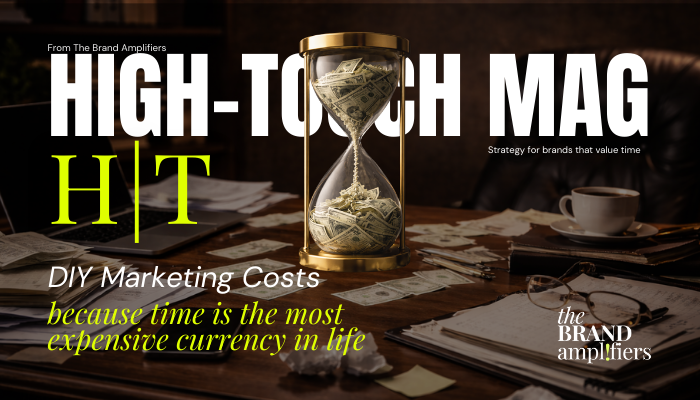
Many founders try to save money by doing their own marketing, but the real cost of DIY marketing is rarely financial. When founders handle their own marketing instead of hiring a brand strategy agency, they often lose time, momentum, and positioning without realizing it. This guide explains why DIY marketing becomes expensive, when founders should stop doing their own marketing, and how strategic brand positioning protects growth, clarity, and long-term value.
If you’re doing your own marketing, it probably feels responsible.
You’re saving money.
You’re staying lean.
You’re “handling it internally.”
But here’s the uncomfortable truth most post-revenue founders don’t want to face:
At some point, every post-revenue founder faces the same decision: continue doing your own marketing or hire a brand strategy partner. While DIY marketing feels responsible, it quietly drains leadership time, slows growth, and weakens brand positioning. This article breaks down the true cost of DIY marketing, explains when founders should hire a marketing agency, and shows how strategic branding protects both momentum and long-term value.
DIY marketing isn’t cheap. It’s one of the most expensive decisions you can make.
Not because you aren’t capable.
Not because you don’t understand your business.
But because you’re paying with the one asset your company can never replenish: time.
And in growing businesses, time is always more valuable than money.
The Lie Founders Tell Themselves About Marketing
At a certain stage, nearly every founder says some version of this:
“We’ll tighten it up later.”
“Marketing isn’t urgent right now.”
“We’re focused on revenue, not branding.”
“I can do this myself for now.”
What they don’t realize is that marketing is already happening, whether they’re intentional about it or not.
Every touchpoint sends a signal:
Your website
Your content
Your inconsistency
Your silence
The question isn’t if your brand is communicating.
It’s what it’s communicating while you’re busy elsewhere.
👉🏾 This is usually the moment founders realize they’re reacting instead of leading.
Book a Private Brand Strategy Intro →
What DIY Marketing Actually Costs (Beyond the Budget)
Most founders measure marketing cost in dollars.
That’s the first mistake.
DIY marketing quietly drains:
Strategic focus – leadership time gets fragmented
Decision quality – rushed, reactive choices replace planning
Momentum – initiatives stall before compounding
Positioning – the brand feels unclear or “unfinished”
Opportunity – competitors show up earlier and stronger
This is why businesses can be “busy” and still stuck.
They’re spending time instead of buying leverage.

Time is the asset you can’t replace. Money is the tool you use to protect it.
Why Time Is the Wrong Currency to Spend
Money is renewable.
Time is not.
Every hour you spend:
Figuring out messaging
Testing content
Managing freelancers
Fixing misalignment
Learning marketing fundamentals
…is an hour not spent on:
Revenue
Partnerships
Operations
Client experience
Growth strategy
No scalable business was built this way.
High-performing companies don’t ask:
“How can I do this myself?”
They ask:
“Who should be doing this instead of me?”
That’s how decades of experience get compressed into months.
The “Cheap” Marketing Trap
When founders finally decide to get help, many try to save money by:
Hiring junior or inexperienced talent
Delegating to family or friends
Working with freelancers without clear scope
Treating branding as cosmetic instead of structural
The outcome is almost always the same:
Fragmented messaging
Disconnected campaigns
Leads that don’t convert
A brand that feels busy but ineffective
Eventually, the business hires a specialist anyway —
after paying twice in lost momentum.
If you think hiring an expert is expensive,
try fixing a year of misalignment.
👉🏾 This is where clarity saves far more than it costs.
What Smart Businesses Do Differently
Companies that scale cleanly don’t “do more marketing.”
They do earlier marketing.
They:
Lock positioning before spending on visibility
Build brand architecture before scaling content
Plan campaigns months ahead, not weeks
Treat marketing like infrastructure, not decoration
They understand one thing deeply:
You don’t prepare for the moment.
You prepare before the moment — so the moment works for you.
When DIY Marketing Starts Holding You Back
DIY marketing stops being responsible and starts being risky when:
You’re post-revenue and growth feels heavier than it should
Marketing lives in your head instead of a system
Content exists but doesn’t convert
Branding matters, but no one owns it
You’re busy, but never ahead
That’s not a motivation issue.
That’s a structure problem.
And structure is exactly what specialists are paid to build.
A Smarter Way Forward
You don’t need:
More posts
Louder ads
Another platform
You need:
Clear positioning
Defined brand architecture
A forward-looking marketing calendar
Specialists who protect your time instead of consuming it
No prominent company built scale by doing everything themselves.
And you shouldn’t want to either.
👉🏾 Start with clarity, not execution.
Book a Private Brand Strategy Intro →
faqs
Why is DIY marketing so expensive for growing businesses?
Because founders pay with time instead of money. Time spent learning, fixing, and guessing marketing decisions delays growth and reduces leadership effectiveness.
How much should businesses invest in marketing?
Most mature service-based businesses allocate 7–12% of annual revenue to marketing. Premium brands often invest toward the higher end to protect positioning and demand.
Isn’t it safer to wait until revenue grows before investing?
Waiting delays compounding. Early strategic investment prevents rework, misalignment, and missed opportunities later.
What’s the difference between branding and marketing?
Branding defines who you are and how you’re perceived.
Marketing amplifies that clarity.
Without branding, marketing creates noise — not demand.
When should a business stop DIY marketing?
When the business is post-revenue, leadership time is constrained, and growth depends on trust, positioning, and consistency.
Want more insights on brand strategy, positioning, and modern marketing?
Explore more expert perspectives in our latest articles and discover how The Brand Amplifiers helps founders build brands that scale with clarity and confidence.
Sources & References
Gartner — Marketing Budget Benchmarks & Strategic Allocation
Provides insight into how high-performing companies allocate marketing spend and why underinvestment slows growth.
👉🏾 https://www.gartner.com/en/marketing/insights/articles/marketing-budgets-benchmarks
HubSpot — How Much Should Businesses Spend on Marketing?
Breaks down average marketing spend as a percentage of revenue across growth stages and industries.
👉🏾 https://blog.hubspot.com/marketing/marketing-budget
Harvard Business Review — Time, Talent, and the Cost of Leadership Distraction
Explores why leadership time is a finite asset and how misallocation undermines long-term performance.
👉🏾 https://hbr.org/2018/07/where-ceos-spend-their-time
McKinsey & Company — The Value of Brand Investment
Examines how strong brands outperform competitors and why early brand strategy accelerates scale.
Forbes — Why DIY Marketing Costs Businesses More Than They Think
Highlights the hidden costs of founder-led and under-resourced marketing efforts.
Deloitte — Growth Strategy for Professional & Premium Services Firms
Discusses why service-based and trust-driven businesses must invest in positioning and go-to-market strategy.
👉🏾 https://www.deloitte.com/global/en/Industries/consumer/analysis/growth-strategy.html
CB Insights — Why Startups Fail
Identifies lack of market positioning and ineffective marketing as leading contributors to stalled growth.
👉🏾 CbinsightsWhy Startups Fail: Top 12 Reasons l CB Insights
