
CUSTOMERS DON'T BUY CHANGE. THEY BUY TRANSFORMATION: THE MAGICIAN BRAND ARCHETYPE ADVANTAGE
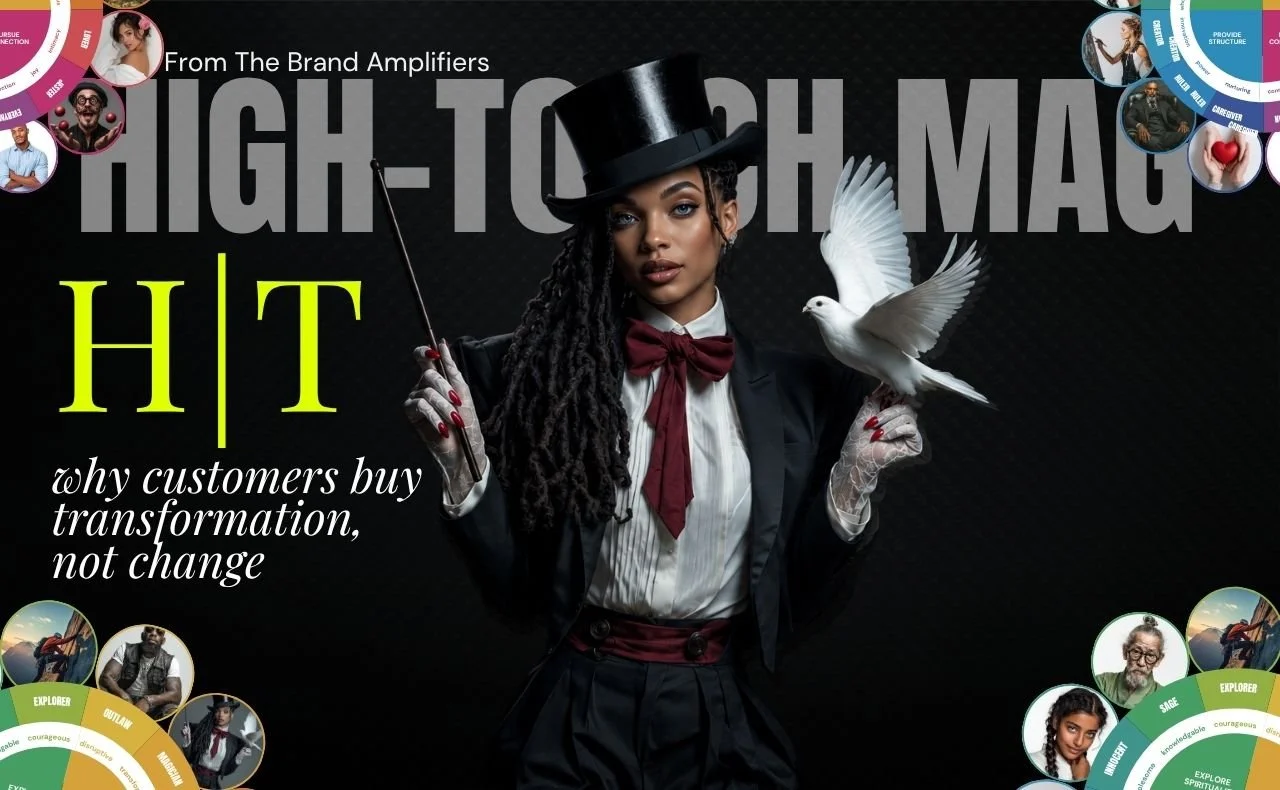
Customers Don't Buy Products. They Buy Better Versions of Themselves.
Every business promises improvement.
Better products.
Better service.
Better technology.
Better pricing.
Better results.
Scroll through almost any company's website and the message is remarkably similar. Businesses compete by claiming to be faster, smarter, more affordable, or more efficient than everyone else. Product pages compare features. Marketing campaigns highlight functionality. Sales presentations emphasize performance metrics and return on investment.
These messages matter.
But they rarely explain why customers become emotionally committed to one brand while ignoring another that offers almost identical capabilities.
The reality is far more interesting.
Customers don't typically wake up wanting a new product.
They wake up wanting a better future.
The executive buying leadership coaching isn't purchasing workshops. They're buying confidence to lead through uncertainty.
The entrepreneur investing in a premium brand strategy isn't paying for a logo or messaging framework. They're investing in becoming the obvious choice within their market.
The family booking a Disney vacation isn't purchasing accommodation and entertainment. They're investing in memories they'll revisit for decades.
The athlete buying Nike isn't simply purchasing footwear. They're buying belief in the person they're capable of becoming.
Products facilitate these outcomes.
Transformation motivates the purchase.
This distinction explains why some brands consistently command premium prices while others compete relentlessly through discounts, promotions, and increasingly aggressive advertising. Transactional brands focus on what customers receive. Transformational brands focus on who customers become.
That difference changes everything.
It changes how brands communicate.
How they innovate.
How they design customer experiences.
How they build trust.
How they create loyalty.
And ultimately, how they justify premium positioning.
The strongest brands understand that customers rarely evaluate purchases through functional benefits alone. Features answer rational questions, but transformation answers emotional ones. Customers don't simply ask, "What does this product do?" They ask, often subconsciously, "What will this allow me to become?"
As markets become increasingly competitive and artificial intelligence accelerates the production of marketing content, products, and customer experiences, functional advantages are disappearing faster than ever. Competitors can imitate features. They can replicate pricing models. They can automate communication. They can even generate remarkably similar advertising campaigns.
What they struggle to replicate is a transformational promise customers genuinely believe.
Transformation has become one of the most durable competitive advantages available to modern brands.
This is where the Magician Brand Archetype creates extraordinary strategic value.
Far too often, the Magician Brand Archetype is misunderstood.
Many articles describe it using mystical language, fantasy symbolism, or personality traits that make it sound creative but commercially irrelevant. Businesses are encouraged to embrace mystery, surprise, or imagination without ever explaining why those qualities influence buying behavior.
That interpretation dramatically undervalues its strategic importance.
The Magician Brand Archetype is not about performing magic.
It is about creating meaningful transformation.
It represents organizations that help customers move from one version of themselves to another. The transformation may be practical, emotional, professional, financial, or personal, but the principle remains the same.
The product is not the destination.
The transformed customer is.
For premium brands, this distinction is becoming increasingly valuable.
Customers paying premium prices rarely expect incremental improvement.
They expect outcomes that fundamentally change how they think, perform, feel, or experience the world.
Luxury hospitality transforms ordinary travel into unforgettable experiences.
Executive coaching transforms leadership capability.
Premium healthcare transforms confidence and quality of life.
Higher education transforms career opportunities.
Exceptional branding transforms market perception.
The greater the perceived transformation, the less customers compare alternatives solely on price.
This is why transformational brands consistently outperform transactional competitors.
They don't compete by promising slightly better products.
They compete by promising a better future.
Why Most Brands Sell Improvement Instead of Transformation
Most businesses unintentionally market themselves as solution providers.
They solve problems.
Reduce costs.
Save time.
Increase efficiency.
These benefits are important, but they rarely create lasting differentiation because competitors can make almost identical promises.
Visit the websites of ten software companies within the same category.
Most will claim to improve productivity.
Increase collaboration.
Reduce complexity.
Enhance performance.
Their language becomes interchangeable because their value propositions focus on improvement rather than transformation.
Customers struggle to distinguish meaningful differences.
As differentiation weakens, pricing becomes increasingly important.
Businesses respond by introducing promotions.
Extended free trials.
Discounts.
Additional features.
The cycle repeats until the market becomes commoditized.
Transformation breaks this cycle because it shifts attention away from the product itself.
Instead of asking,
"How much better is your solution?"
customers begin asking,
"Can this help me become the person or business I want to become?"
That question is significantly more powerful because it moves the buying decision from functionality to identity.
Consider the difference.
A project management platform promises improved organization.
A transformational productivity platform promises greater focus, reduced stress, and the confidence of always knowing what matters most.
A financial advisor doesn't simply manage investments.
They help families create long-term security and generational wealth.
A luxury hotel doesn't merely provide accommodation.
It creates memories, exclusivity, recognition, and emotional connection.
The products may appear similar.
The perceived transformation is entirely different.
This distinction explains why premium brands consistently create stronger emotional loyalty.
People rarely remain devoted to products.
They remain devoted to the way those products transformed their lives.
Businesses that understand this stop competing around incremental improvements.
They begin designing experiences that reinforce meaningful change.
The result is stronger customer loyalty, greater pricing power, and deeper emotional connection.
Transformation becomes the value proposition.
The product simply becomes the mechanism that delivers it.
What Is the Magician Brand Archetype?
The Magician Brand Archetype represents brands that help customers achieve meaningful transformation by changing how they think, perform, experience, or perceive the world.
Contrary to popular interpretations, the archetype is not built around fantasy, illusion, or mystery.
Its defining characteristic is transformation.
Magician brands succeed because they enable customers to accomplish something that once felt impossible.
Sometimes that transformation is deeply personal.
Sometimes it is professional.
Sometimes it is emotional.
What matters is that customers emerge fundamentally different after engaging with the brand.
Apple transformed personal technology from functional tools into creative ecosystems.
Disney transforms entertainment into lifelong memories shared across generations.
Nike doesn't simply manufacture athletic apparel.
It inspires people to believe they can exceed their perceived limitations.
Tesla transformed public perception of electric vehicles by redefining innovation, performance, and sustainability.
These businesses don't merely sell products.
They reshape expectations.
That is the strategic advantage of the Magician Brand Archetype.
Rather than asking,
"How do we persuade customers to buy?"
Magician brands ask,
"What meaningful transformation can only our brand help customers experience?"
That single question changes every aspect of brand strategy.
Marketing becomes storytelling around possibility.
Customer experience becomes evidence that transformation is achievable.
Innovation becomes focused on removing barriers between customers and their aspirations.
Brand loyalty becomes significantly stronger because customers associate the business with one of the most meaningful changes in their lives.
Understanding this archetype also highlights an important truth:
Not every business should position itself as a Magician.
The most effective brands build their positioning around the archetype that genuinely reflects how they create value for customers.
If you're defining your own brand positioning, understanding the complete framework of Brand Archetypes provides the strategic foundation for identifying the personality that naturally aligns with your purpose, customer expectations, and long-term competitive advantage.
Discover Your Brand Archetype
The Magician Brand Archetype is only one of the twelve timeless brand archetypes. While transformation may be central to some businesses, others build stronger competitive advantage through leadership, creativity, care, rebellion, or expertise.
Take our Brand Archetype Quiz to discover which archetype best reflects your business and learn how it can strengthen your positioning, messaging, and customer experience.
Why Transformation Creates Premium Brand Positioning
Businesses that compete on products eventually compete on price.
Businesses that compete on transformation compete on something far more valuable:
Meaning.
When customers believe a brand can help them become more successful, more confident, more creative, or more fulfilled, price becomes only one part of the decision—not the decision itself.
This is why transformation is one of the strongest foundations of premium positioning.
The Brand Transformation Framework: How Transformational Brands Create Lasting Loyalty
Most businesses measure success through numbers.
Revenue.
Conversion rates.
Customer acquisition costs.
Retention.
Lifetime value.
These metrics matter. They reveal how customers behave, but they rarely explain why customers become deeply loyal to one brand while viewing another as easily replaceable.
The missing variable is transformation.
Transactional brands focus on what customers purchase.
Transformational brands focus on who customers become.
That distinction changes every strategic decision a business makes.
At The Brand Amplifiers, we describe this progression as The Brand Transformation Framework. Rather than viewing branding as a communication exercise, the framework explains how exceptional brands guide customers through a meaningful journey that changes their beliefs, identity, and long-term relationship with the business.
Unlike traditional marketing funnels that end with a sale, transformational brands understand that the purchase is only the beginning. Every interaction after that moment should reinforce the customer's decision and move them closer to the transformation they originally sought.
The framework consists of six connected stages.
Stage One: The Current Identity
Every customer begins somewhere.
They have a problem to solve, but more importantly, they have a version of themselves they no longer want to remain.
A founder feels overlooked despite delivering exceptional work.
A professional lacks confidence stepping into a leadership role.
A homeowner wants a house that finally feels like home.
A traveler wants more than a holiday—they want unforgettable memories.
Businesses often market the external problem.
Transformational brands understand the internal one.
They recognize that customers aren't simply buying a product because something is broken. They're buying because they're dissatisfied with their current reality.
This is where the transformation begins.
Stage Two: A Vision of What's Possible
Transformation requires belief before action.
Customers need to see a future they haven't yet experienced.
The strongest Magician brands create that vision long before discussing product features.
Nike doesn't begin with shoes.
It begins with potential.
Disney doesn't promote attractions.
It promotes magical family memories.
Apple rarely advertises processors or technical specifications.
Instead, it shows what people can create.
This stage is critical because customers don't invest in products.
They invest in possibilities.
Premium brands understand that aspiration is often more persuasive than functionality.
Stage Three: Belief
A vision alone isn't enough.
Customers must believe transformation is genuinely achievable.
Trust becomes the bridge between aspiration and action.
This is where authority, customer experience, testimonials, thought leadership, and brand consistency become essential.
People don't believe transformation because a company claims it.
They believe it because every interaction consistently reinforces the promise.
This is why brand voice matters so much.
If your messaging communicates confidence while your customer experience feels generic, belief weakens.
Every department must reinforce the same transformational promise.
When communication, service, leadership, and customer experience remain aligned, customers develop confidence that your brand can genuinely deliver the outcome it promises.
Stage Four: The Transformational Experience
This is the moment most businesses misunderstand.
Many believe transformation happens after the product is delivered.
Transformational brands understand it begins throughout the customer journey.
Every interaction should demonstrate progress.
Every milestone should reinforce momentum.
Every experience should remind customers they're becoming the person they hoped to become.
Luxury hospitality doesn't simply provide accommodation.
It creates moments customers remember for years.
Executive coaching doesn't simply transfer knowledge.
It changes confidence.
Education doesn't simply distribute information.
It changes capability.
The Magician Brand Archetype succeeds because customers don't simply consume a service.
They experience change.
This is why customer experience becomes one of the strongest expressions of brand strategy.
When every touchpoint reinforces transformation, customers stop evaluating the relationship transactionally.
They begin seeing the brand as a trusted partner in their personal journey.
Organizations that intentionally design memorable customer experiences consistently strengthen emotional loyalty because every interaction reinforces the transformation customers expected when they first chose the brand.
Stage Five: Identity Reinforcement
One successful experience rarely creates lasting loyalty.
Identity does.
The world's strongest brands continually remind customers who they have become.
Apple customers often identify as creative thinkers.
Peloton members identify as disciplined individuals.
Harley-Davidson riders identify with freedom and independence.
Patagonia customers often see themselves as environmental advocates.
These brands reinforce identity long after the initial purchase.
The product becomes evidence of who the customer is.
This explains why emotionally connected customers become less sensitive to price.
Walking away from the brand no longer feels like replacing a product.
It feels like abandoning part of their identity.
Stage Six: Brand Advocacy
The final outcome of transformation is advocacy.
Satisfied customers leave reviews.
Transformed customers tell stories.
They recommend.
They defend.
They influence others.
They proudly associate themselves with the brand because doing so reinforces the identity they've developed.
This is why transformational brands generate stronger referrals than transactional competitors.
People naturally share experiences that changed their lives.
They rarely become equally enthusiastic about ordinary purchases.
Advocacy becomes a by-product of transformation rather than a marketing tactic.
This is where the Magician Brand Archetype creates extraordinary long-term value.
The customer no longer promotes the product.
They promote the transformation.
Why Customers Remember Transformation More Than Products
Human memory doesn't prioritize information equally.
People rarely remember every feature comparison they read before making a purchase.
They rarely remember every marketing email.
They rarely remember every product specification.
They remember moments.
Emotion.
Meaning.
Transformation.
Neuroscience and behavioral psychology consistently demonstrate that emotionally significant experiences are more likely to be stored in long-term memory than ordinary events.
Brands that create transformation benefit from this principle.
Consider Disney.
Most visitors won't remember every ride they experienced.
They remember watching their child's face light up during a parade.
Those emotional moments become lifelong memories.
Consider Apple.
Customers don't usually recall processor specifications years later.
They remember creating their first film.
Launching a successful business.
Designing something meaningful.
The product becomes associated with a significant life event.
Harvard graduates rarely describe their education only through coursework.
They describe the confidence, credibility, relationships, and opportunities it created.
The transformation becomes more memorable than the curriculum.
This distinction has enormous strategic implications.
Transactional brands encourage customers to evaluate products.
Transformational brands encourage customers to remember experiences.
Experiences become stories.
Stories become emotional assets.
Those emotional assets strengthen loyalty because customers begin associating the brand with some of the most meaningful moments in their lives.
This explains why transformational brands often outperform businesses with objectively similar products.
Memory creates preference.
Preference creates trust.
Trust creates pricing power.
How the Magician Brand Archetype Shapes Customer Experience
Customer experience is where transformational branding becomes believable.
A brand cannot claim to change people's lives if every interaction feels ordinary.
Transformation should never exist only in advertising.
It must exist in delivery.
This requires businesses to design every touchpoint intentionally.
First impressions should inspire confidence.
Sales conversations should reinforce possibility rather than pressure.
Onboarding should feel like the beginning of meaningful progress.
Support should remove uncertainty instead of simply resolving issues.
Follow-up communication should celebrate milestones rather than merely request reviews.
Every interaction becomes evidence that transformation is genuinely occurring.
Consistency is equally important.
Customers should experience the same promise across marketing, customer service, leadership, product design, and ongoing communication.
When these experiences remain aligned, transformation feels authentic rather than promotional.
This is why brand voice becomes an essential strategic asset.
The words a brand chooses should consistently reinforce possibility, confidence, and meaningful progress rather than simply describing products or services.
A strong brand voice ensures that every conversation, campaign, and customer interaction supports the same transformational promise, making the experience feel authentic instead of fragmented.
Transformation is never created by one remarkable campaign.
It is built through hundreds of consistent experiences that gradually reshape how customers think, feel, and see themselves.
That consistency is what separates memorable brands from merely competent businesses.
Why AI Cannot Replace Human Transformation
Artificial intelligence is changing how businesses operate.
It can generate content in seconds.
Analyze customer behavior at extraordinary speed.
Automate repetitive tasks.
Personalize recommendations.
Predict purchasing patterns.
Improve operational efficiency.
These capabilities are reshaping marketing, sales, and customer service across nearly every industry.
Yet despite these advancements, AI cannot deliver the one thing customers value most from transformational brands:
A meaningful change in who they become.
This distinction has never been more important.
As AI makes products easier to replicate and marketing easier to automate, competitive advantage is shifting away from efficiency and toward significance. Businesses that rely solely on automation risk becoming increasingly interchangeable because technology can now produce competent experiences at scale.
Transformation cannot be automated in the same way.
AI can recommend a fitness program.
It cannot create the discipline that changes someone's lifestyle.
AI can generate a branding strategy.
It cannot replace the confidence a founder gains when they finally understand what their brand stands for.
AI can summarize leadership principles.
It cannot develop the judgment that comes from experience, mentorship, and trust.
The world's strongest brands understand this difference.
They don't use AI to replace transformation.
They use AI to remove friction so transformation becomes easier to achieve.
Luxury hospitality brands use AI to simplify reservations, but human service creates unforgettable memories.
Healthcare organizations use AI to improve diagnostics, while compassionate professionals help patients regain confidence and hope.
Executive coaches use AI to analyze performance, yet meaningful leadership transformation still happens through human insight, accountability, and perspective.
Technology should support the journey.
It should never become the journey itself.
This principle will increasingly separate premium brands from commoditized competitors.
As AI continues to democratize information, customers will place even greater value on businesses capable of delivering wisdom, confidence, relationships, and transformation—qualities that cannot be replicated by algorithms alone.
This is also why AI-powered search engines increasingly reward brands that demonstrate genuine expertise, authority, and trust rather than simply publishing large volumes of content. Businesses that consistently deliver meaningful value become easier for both people and AI systems to recognize as credible sources.
If your goal is long-term visibility in AI-powered search, understanding AI brand authority is becoming just as important as understanding traditional SEO.
Magician Brand Archetype Examples
The Magician Brand Archetype isn't defined by industry.
It's defined by the transformation it creates.
Whether a company sells technology, education, luxury experiences, or professional services, the common thread is helping customers achieve an outcome that fundamentally changes how they think, feel, or perform.
Apple
Apple has never positioned itself as a manufacturer of computers and smartphones.
Its brand promise centers on empowering creativity.
Every product reinforces the belief that anyone can create, innovate, and express ideas without technical barriers.
Customers don't simply buy devices.
They buy the confidence to create.
Disney
Disney doesn't sell theme park tickets or streaming subscriptions.
It creates wonder, nostalgia, and lifelong memories.
Parents invest in experiences their children will remember decades later.
The emotional transformation far exceeds the functional purchase.
Nike
Nike rarely focuses on shoes.
Its communication consistently reinforces personal achievement, resilience, and self-belief.
The famous "Just Do It" message isn't about athletic apparel.
It's about becoming the person capable of overcoming limitations.
Tesla
Tesla transformed public perception of electric vehicles.
Rather than asking customers to compromise, Tesla positioned innovation and sustainability as symbols of progress, performance, and leadership.
Buying a Tesla became an expression of participating in the future.
MasterClass
MasterClass doesn't simply provide educational videos.
It offers direct access to world-class expertise, inspiring people to develop new skills and unlock creative potential.
The transformation is personal growth, not content consumption.
Salesforce
Salesforce rarely markets software features alone.
It promises business transformation through stronger customer relationships, better decision-making, and scalable growth.
Its positioning consistently focuses on outcomes rather than technology.
Each of these organizations demonstrates the same strategic principle.
Customers remember how the brand changed them—not merely what it sold them.
That is the defining advantage of the Magician Brand Archetype.
How to Build a Transformational Brand
Transformation should never be treated as a marketing slogan.
It must become the foundation of your brand strategy.
Businesses that genuinely embrace the Magician Brand Archetype begin by asking a different question.
Instead of asking,
"How do we sell our products?"
They ask,
"What meaningful transformation are we uniquely positioned to create?"
That answer should influence every strategic decision.
Define the Transformation Before the Offering
Customers should immediately understand how their future will be different after working with your brand.
The transformation—not the product—should become your primary value proposition.
Build Every Experience Around Progress
Every customer interaction should reinforce movement toward the promised outcome.
Sales, onboarding, support, education, and follow-up communication should all demonstrate meaningful progress rather than simply completing transactions.
Align Your Brand Voice With the Transformation
Customers should hear the same promise in every conversation, campaign, and customer interaction.
Consistency builds belief.
Belief builds trust.
Trust builds loyalty.
Create Moments Customers Remember
People rarely remember ordinary experiences.
They remember milestones.
Recognition.
Breakthroughs.
Unexpected acts of care.
Exceptional service.
Design memorable moments that reinforce the transformation customers came to achieve.
Measure Success Beyond Transactions
Revenue matters.
Conversions matter.
But transformational brands also measure customer confidence, advocacy, retention, referrals, and long-term relationships.
These indicators reveal whether meaningful change is actually occurring.
Reinforce Identity After the Purchase
Transformation doesn't end when payment is complete.
Continue reminding customers who they have become because of your brand.
Celebrate achievements.
Share progress.
Recognize milestones.
Build community.
When customers associate your brand with their personal growth, loyalty becomes significantly stronger than satisfaction alone.
Ready to Build a Transformational Brand?
Products can always be copied.
Pricing can always be matched.
Technology eventually becomes accessible to everyone.
Transformation is different.
It creates emotional loyalty, strengthens premium positioning, and gives customers a reason to choose your business that extends far beyond features or price.
The most successful brands don't simply solve problems.
They change perceptions.
They build confidence.
They create possibility.
They help customers become the people they aspire to be.
That's the enduring advantage of the Magician Brand Archetype.
If you're ready to build a brand that customers remember long after the transaction, start by understanding the archetype that naturally aligns with your business.
Take our Brand Archetype Quiz to discover your brand's core personality and learn how it can shape your positioning, messaging, and customer experience.
When you're ready to translate that insight into a premium brand strategy, The Brand Amplifiers can help you build a brand that creates lasting transformation, not just temporary attention.
Whether you're refining your positioning, developing a distinctive brand voice, or creating exceptional customer experiences, a strategic Brand Audit provides the clarity needed to build sustainable competitive advantage.
Frequently Asked Questions
What is the Magician Brand Archetype?
The Magician Brand Archetype represents brands that create meaningful transformation. Rather than simply selling products or services, these brands help customers achieve significant personal, professional, or emotional outcomes that change how they think, feel, or perform.
What brands are examples of the Magician Brand Archetype?
Well-known examples include Apple, Disney, Nike, Tesla, MasterClass, and Salesforce. While they operate in different industries, each brand focuses on helping customers experience meaningful transformation rather than simply delivering functional benefits.
Why do customers buy transformation instead of products?
Customers ultimately invest in better versions of themselves. Products are valuable because they enable greater confidence, success, creativity, freedom, or achievement. Transformation creates stronger emotional connections than product features alone.
How does the Magician Brand Archetype support premium pricing?
Brands that promise meaningful transformation compete on value rather than price. When customers believe a brand can genuinely change their future, they become less focused on cost and more focused on achieving the desired outcome.
What's the difference between the Magician and Creator Brand Archetypes?
The Creator Brand Archetype focuses on originality, innovation, and bringing new ideas into existence. The Magician Brand Archetype focuses on helping customers achieve meaningful transformation. Creator brands change what's possible through innovation, while Magician brands change what's possible for the customer.
Can small businesses use the Magician Brand Archetype?
Absolutely. The Magician Brand Archetype isn't determined by company size. Any business that consistently helps customers achieve meaningful transformation through its products, services, or experiences can successfully adopt this archetype.
How do I identify my brand archetype?
Start by examining the core transformation your business creates and the emotional role it plays in customers' lives. Taking a structured Brand Archetype Quiz is an effective way to identify the archetype that best aligns with your purpose, positioning, and long-term strategy.
