
HOW MUCH SHOULD HOTELIERS REALLY SPEND ON MARKETING IN 2026?
2025 Hospitality Marketing Budgets: What Smart Hotels Spend and Why
Marketing budgets across industries rose in clarity this year-but hoteliers remain behind. Global benchmarks suggest 7.7–9.4% of revenue goes toward marketing in 2025, while many hotels invest under 2.5%. That discrepancy isn't just a missing line item-it’s a missed opportunity. Let's dig into the numbers, the recommendations from hospitality experts, and the smarter way forward. For example, aligning your hotel’s marketing strategy with major global events can dramatically improve results, as explored in FIFA 2026 STRATEGY for SMART BRANDS.
What the Numbers Say-Marketing Budgets in 2025
The Gartner CMO Spend Survey shows marketing budgets stalled at 7.7% of company revenue in 2025-unchanged from 2024.
Another benchmark report places the average even higher at 9.4% of revenue.
Generally, B2C brands spend 5–10%, while agencies like HubSpot report small businesses commit ~7–8%, and general companies around 9.1%.
Yet in hospitality, U.S. hoteliers average just under 2.5% of room revenue on marketing (including payroll).
Meanwhile, OTAs like Expedia spend 54% of revenue-or $6.9B in 2024-on marketing and sales.
Don’t let your marketing budget get stuck at 2%. It’s time to invest in your story – before OTAs spend your potential customers’ attention (and your profit) for you.
Hoteliers Speak-Experts’ Perspectives
Adam Mogelonsky (Hotel Mogel Consulting):
Spend 5–10% of revenue-but focus on unique channels where OTAs don't dominate: social, influencers, CRM, events, FAMs, PR, co‑branding, and advisor partnerships.
Erik Muñoz (SuitePad):
Guideline by property stage:
New hotels: ~10% of projected revenue
Established: 4–6%
Luxury: Up to 8%
Seasonality matters: boost spend 20–30% in high season, maintain in shoulder, reduce or reallocate in low.
Frederic Gonzalo:
Spend varies by lifecycle stage:
Launch stage: 15–25% on marketing.
Maturity: 5–10% is sufficient.
Adjust spending based on goals, location changes, or market shifts.
Max Starkov:
Hotels spend too little on direct marketing, letting OTAs siphon bookings. Invest 4–6% of revenue on marketing not including payroll and prioritize technologies (CRM, chatbots, RMS, ORM) to reduce dependency.
Linchi Kwok (Cal Poly Pomona):
Recommends a baseline 5% of room revenue, but if you're leaning into AI-driven content or loyalty tech, consider moving closer to 10%. Otherwise, OTAs will continue dominating.
Simone Puorto (Hospitality Net):
Define what “marketing” includes. OTAs, metasearch, and tech are not always pure marketing. Rule of thumb:
Focused (direct bookings): Maintain 10–12% cost per acquisition
Mid-funnel: Budget ~15% of revenue
Brand/Top-of-funnel ambition: Allocate up to 20%.
Peter O’Connor (Uni of South Australia):
If hotels still spend <3% on marketing yet pay 15–20% in OTA commissions, that's backwards. Direct bookings deliver more profit and loyalty spend more on growing your own channels.
Hoteliers vs. OTAs-The Contrast in Billion-Dollar Numbers
To put it plainly, hotels are underspending on marketing compared to the very distributors (OTAs) that dominate online bookings. Consider the side-by-side comparison:
| Entity | Marketing Spend vs Revenue |
|---|---|
| Hotel (Average) | ~2.5% |
| Recommended Range | 5–10% (launch to luxury tier) |
| OTAs (e.g. Expedia) | 54% (2024) |
Spending less than 3% while distributors spend 50%+ is a losing strategy. To regain autonomy and profit, hoteliers must invest more intelligently.
In other words, the typical hotel spends under 3% on marketing, while online travel giants spend 50%+. Spending so little on your own marketing while intermediaries spend 20x more to grab your customers is a losing strategy. To regain autonomy and profit, hoteliers need to invest more and invest smarter in marketing.
Stop paying OTA commissions as a substitute for marketing. Instead, invest that budget in your own brand and watch direct bookings (and profits) climb.
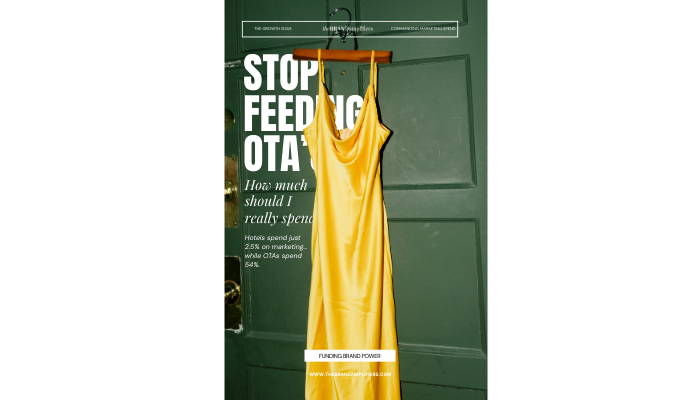
Stop feeding OTAs. Hotels invest just 2.5% in marketing while OTAs spend 54%. Command your budget and fund brand power.
Recommendations-Smart Spending Tied to Strategy
How can hotels close the gap and spend their marketing dollars more effectively? These key recommendations emerged from the data and expert insights:
Align Budget with Business Stage:
Calibrate your marketing spend to where your property is in its lifecycle. Launching a new hotel or brand? You may need to devote 15–25% of projected revenue to make a splash. An established property sustaining its position can target 5–10% to maintain growth. If you have high expansion ambitions or a major repositioning (e.g. entering a new market or post-renovation relaunch), be prepared to stretch up toward 20% for a period. In short, new ventures need big awareness spends, whereas mature operations can focus on efficiency.
Track the Full Funnel:
Don’t pour your entire budget into just one part of the customer journey. Allocate funds across the full marketing funnel – from broad awareness at the top, to engagement/consideration in the middle, down to conversion tactics for direct bookings at the bottom. For example, set aside budget percentages for each stage (perhaps using Simone’s 10/15/20% guide for lower/mid/upper funnel focus. Then measure ROI at each stage. By auditing spend vs. return in awareness, mid-funnel, and conversion campaigns, you can optimize and reallocate on the fly. A balanced, data-driven approach ensures you’re not overweighting one funnel stage while starving another.
Seasonally Optimize:
Hotels live and die by seasonality, and so should their marketing budgets. Plan to increase your marketing spend by ~20–30% in high season when demand (and competition for guests) is greatest. During shoulder seasons, maintain a steady presence to capture available business. And in low seasons, don’t just slash the budget to zero – reallocate it strategically. For instance, invest in content creation, SEO, or advance booking promotions for the next peak, or target off-season segments. The key is dynamic budgeting: spend more when it counts the most, but make every dollar work year-round by timing it to traveler demand.
Invest in Tech + Storytelling:
Budget for the tools and content that can set you apart. This means allocating funds for CRM systems, analytics, AI, and marketing automation that can personalize and elevate the guest experience (many experts noted that tech is underfunded in hotel marketing). It also means investing in brand storytelling and content – areas like social media, video, community building, and PR that create an emotional connection. Remember Max Starkov’s point: technology that enhances direct engagement (chatbots, guest apps, etc.) can reduce reliance on OTAs. And Linchi Kwok emphasized content’s role in an AI-driven search world. So, spend on the infrastructure (tech) and the soul (storytelling) of your marketing. Tomorrow’s travelers value authentic experiences, not just room rates.
Plan for ROI, Not Just Spend:
It’s not about having the biggest budget – it’s about using what you have efficiently. As Gartner’s 2025 survey noted, budgets are flat and many CMOs feel they lack enough funds, so they’re turning to productivity and optimization to do more with less. Hoteliers should take the same approach. Set clear ROI goals for each marketing dollar.
For example, instead of saying “we’ll spend 7% of revenue on marketing because that’s the norm,” break that 7% down into actionable targets (X% for paid media with expected return of Y direct bookings, Z% for CRM loyalty with expected increase in repeat stays, etc.). Use tools to track performance, and be ready to reallocate budget to the highest performers. The focus should be on efficiency and outcomes – every dollar should count. If a tactic isn’t performing, cut it and funnel that budget elsewhere. In 2025, marketing success is about smarter allocation, not necessarily a larger allocation.
Align Budget with Business Stage
Launching a property? Lean into 15–25%. Established? 5–10% sustains growth. High ambition/expansion? Stretch toward 20%.
Track the Full Funnel
Audited spend vs. ROI: craft overflight budgets for awareness, mid-funnel engagement, and direct booking conversions.
Seasonally Optimize
Adjust budgets +20–30% in high season, maintain or reduce in low seasons—thinking toward yield, not just volume.
Invest in Tech + Storytelling
Use CRM, AI, content marketing, social media, loyalty systems, and brand storytelling to build value—because tomorrow’s travel buyers value experience, not just price.
Plan for ROI, Not Just Spend
As Gartner notes: Budgets are flat at 7.7%, so CMOs (and hoteliers) must learn to do more with less, through sharper allocation and technology.
👉🏾Stop underfunding your brand. Invest where it counts — direct demand, CRM, and storytelling. Full analysis here - Thebrandamplifiers
Final Thought
If your hotel is still only spending ~2–3% of revenue on marketing, you’re investing less than half of what most industries do – and likely handing over a large chunk of your profits to OTA commissions in the process. In an era of heightened competition and high customer acquisition costs, marketing is not a luxury; it’s a lifeline. The smartest hoteliers are doubling or tripling their marketing allocation not for the sake of spending more, but because they know every dollar spent on the right initiatives returns value. It’s about quality and strategy: using tech, data, and creative storytelling to make your marketing budget punch above its weight.
In 2025 and beyond, playing it safe at <3% means staying invisible. To secure your future, consider budgeting more (5%, 10%, even 15–20% depending on your goals) – and make those dollars work harder than ever through savvy strategy. More spend alone isn’t a silver bullet, but spending enough on the right things is how you take back control of your bookings, your customer relationships, and your profit margin. Strategy, technology, and storytelling should guide that increase, not fear.
👉🏾 Command your growth. Book a private consultation now : Book Here.
thebrandamplifiers.com/blog/hotel-marketing-budgets-2025
👉🏾 Read Next : How to Create a Brand Guideline That Protects Trust and Drives Growth
A bigger budget without brand discipline is wasted spend. Protect your margin by aligning your identity before you scale.
👉🏾 Featured Inspiration : Ben Trodd × Four Seasons Yachts: Luxury Leadership
Premium leadership in action: Four Seasons proves how vision and brand consistency set the standard for hospitality.
FAQs-Hotel Marketing Budgets
Q1. What percentage of revenue should hotels spend on marketing?
Most experts recommend 5–10% of revenue, with launches requiring 15–25%. Hotels averaging under 3% are far below industry benchmarks.
Takeaway: Spend at least 2–3x more than the current hotel average to compete with OTAs.
Q2. Why do OTAs spend so much on marketing?
OTAs like Expedia spend over 50% of their revenue on marketing because customer acquisition is their business model. Their spend sets consumer expectations—and hotels can’t compete without smart investment in direct channels.
Takeaway: OTAs are buying your guests. Outspend them intelligently to win them back.
Q3. What’s the biggest mistake hotels make with budgets?
Failing to distinguish between payroll and true marketing spend. Many hotels roll payroll into “marketing,” masking how little is allocated to campaigns, storytelling, and demand generation.
Takeaway: Separate payroll from marketing—and hold your spend accountable to ROI.
Q4. How can hotels increase ROI without overspending?
Use CRM, AI-driven personalization, and brand storytelling to target high-value guests. Seasonal optimization (+20–30% in high season) also ensures spend works hardest when demand peaks.
Takeaway: Spend where the yield is, not just where the volume is.
Citations:
Gartner CMO Spend Survey (2025) – Marketing budgets as a % of company revenue.
HubSpot Blog – Marketing benchmarks for SMBs and hospitality, plus budget allocation insights.
Marketing Brew – Industry budget comparisons, OTA vs hotel spend, and expert commentary.
Nasdaq – Reports on global marketing spend and business outlook for 2025.
Awisee Report – Benchmark data placing average marketing spend at 9.4% of revenue.
AwiseeLink Building Services Agency Europe - SEO Outreach globally
MediaBrief – Insights on how marketers allocate budgets amid stagnant growth.
Licera Inc. – Hospitality-focused insights on how U.S. hotels underinvest in marketing.
Marketing Explainers – Breakdown of OTA vs hotel marketing budgets, including Expedia case study.
Hospitality Net – Simone Puorto and other expert voices on hotel marketing strategies and benchmarks.
Business of Fashion (BoF Brand Magic Index, 2024) – Case studies on Dior, Balmain, Tod’s showing brand/customer archetype alignment.
